Camping power is a different problem than home backup. You don't need 3,000Wh. You need something light enough to carry, tough enough to handle rain and dust, and capable of running a CPAP overnight without babysitting it. These five units nail that brief.
1. Jackery Explorer 1000
Still the benchmark for car camping. At 22 pounds it loads into a truck bed one-handed. Three AC outlets handle almost any campsite load. The Jackery SolarSaga 100 panels fold flat and prop up with integrated legs — a small thing that feels huge when you're setting up at 6am. Battery life is real 1kWh of usable output, not marketing wattage.
Downsides: old-school Li-ion chemistry at 500 cycles to 80%, and the AC recharge is slow at about 7 hours. For campers who use the unit 20 times a year, this is fine. For heavier use, look at the Delta 2 below.
Check Price on Amazon →2. EcoFlow Delta 2
For van lifers and overlanders who live out of their vehicle for weeks at a time, charging speed matters. The Delta 2 recharges from a 12V cigarette socket faster than any competitor, and the 1,800W sustained output handles induction cooktops, hair dryers, coffee makers — the stuff that trips 1,000W units. LiFePO4 chemistry means this unit will outlast two or three Jackerys of similar capacity.
Check Price on Amazon →3. Jackery Explorer 300
Backpacking, motorcycle camping, or weekend car camping where you don't need to run a fridge. 7 pounds and small enough to live in a backpack. Runs a CPAP for 6-8 hours, charges phones 15+ times, and powers a laptop or small fan for most of a night. For the right buyer — someone who just needs enough juice to keep devices alive — this is all the power station you need.
Check Price on Amazon →4. Goal Zero Yeti 1000 Core
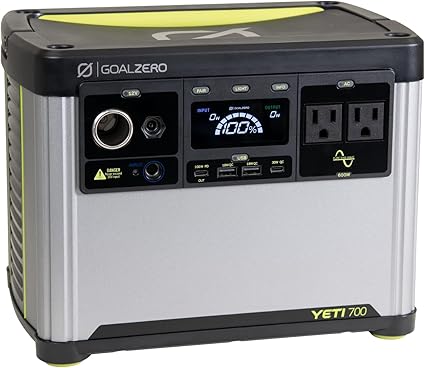
Overlanders beat on their gear. Dust, vibration, repeated loads, extreme temperatures. The Yeti 1000 Core is the unit built for that abuse. Metal chassis, sealed ports, and Goal Zero's Boulder solar panels are the most rugged in the business — 100W panels that survive getting strapped to a roof rack for 50,000 miles of washboard road.
 Check Price on Amazon →
5. Bluetti EB70S
The sweet-spot compromise between the 300Wh ultralights and the 1kWh heavyweights. LiFePO4 chemistry at a price point where most competitors are still shipping old Li-ion. 800W sustained output handles most campsite needs except hair dryers and induction cooktops. Four AC outlets, USB-C PD 100W, and a 12V car port. Solid choice for weekend campers who want longevity without spending Delta 2 money.
Check Price on Amazon →What to Look For in a Camping Power Station
Weight
Every pound matters. A 60-pound Bluetti AC200P makes great home backup but you'll hate it at the campsite. Target under 30 pounds for car camping, under 10 for backpacking-adjacent use. Handles matter too — integrated carry handles beat rope loops.
Solar Input
If you're out more than two nights, you need solar input. Check the max solar watts accepted and the input voltage range. Most campers buy 100-200W of panels — enough to top off overnight losses during the day. For van life, step up to 400W.
Weather Resistance
Most power stations have zero IP rating. Plan to shelter them under an awning or in your vehicle. A few units (Goal Zero Yeti X series, some Ecoflow models) have better sealing. Don't leave any of them in the rain regardless.
Output Ports
Count your plugs. A campsite typically needs 2 AC (fan, coffee maker), 2-3 USB-A (phones), 1 USB-C PD (laptop or modern phone), and 1 12V (cooler). Anything less and you'll run out of ports. Anything more is bonus.
Noise
Fans kick on at high loads and some units are loud. For car camping where you're running a CPAP next to the unit, fan noise is a deal-breaker. EcoFlow Delta 2 and Goal Zero Yeti are quieter than Jackery and Bluetti at full output.
How to Plan Your Camping Power Budget
Rough energy budget for a typical 3-day car camping trip:
- Phone charging (2 phones × 3 days): 90Wh
- Small fan overnight (3 nights × 20W × 8 hrs): 480Wh
- CPAP (3 nights × 40W × 7 hrs): 840Wh
- Coffee maker (3 mornings × 600W × 10 min): 300Wh
- LED lights (3 evenings × 10W × 4 hrs): 120Wh
Total: ~1,830Wh across three days. Without solar, you'd want two 1kWh units or one 2kWh unit. With 200W of solar and reasonably sunny days, one 1kWh unit can keep up. That's why we recommend 1,000Wh as the sweet spot for serious car campers.
Frequently Asked Questions
What size power station do I need for camping?
For a weekend of car camping with phones, lights, and a small fan, 300-500Wh is plenty. For a week of van life or overlanding with a fridge, CPAP, or induction cooktop, you want 1,000Wh minimum. For extended off-grid trips, pair a 1,000-1,500Wh station with 200W+ of solar.
How do I charge a power station while camping?
Solar panels are the primary off-grid option. Most modern units accept 100-400W solar input through MC4 or Anderson connectors. You can also charge from your vehicle's 12V socket while driving — expect 60-100W of input, which adds about 10-15% per hour to a 1kWh unit.
Will a power station run my CPAP all night?
Yes. A typical CPAP without humidifier draws 30-40W and will run 12-20 hours on a 500Wh station. Turn off the humidifier and heated tube to double your runtime. The Jackery Explorer 500 and EcoFlow River 2 are both rated for 2-3 nights of CPAP use.
Can I use a power station in cold weather?
LiFePO4 batteries work reliably down to about 14°F (-10°C) for discharge, but charging performance drops significantly below freezing. Keep the unit in your tent or vehicle overnight rather than in an open truck bed. Some units have built-in heaters for sub-freezing operation.
Do power stations work with RV solar panels?
Generally yes, as long as voltage matches. Most portable power stations accept 10.5-60V solar input, which covers most residential and RV panels. Use an MC4 to Anderson or XT60 adapter to match your station's input port. Verify max input voltage before connecting larger panels.
