Home backup is a different game than camping. Portability stops mattering as much — you want capacity, surge handling for fridge startup, and expandability so you're not stuck at one battery when you realize you need more. These five units are built for sitting in a utility room, ready for the next storm.
1. Anker SOLIX F2000 (767)
Purpose-built for home backup. 2,048Wh base capacity, expandable to 4,096Wh with a single add-on battery. The 2,400W sustained output with 3,600W surge handles refrigerator startup loads, well pumps up to 3/4 HP, and most power tools. LiFePO4 chemistry is EV-grade at 3,000 cycles to 80%.
What makes it the home backup winner: GaNPrime AC charging tops the base unit from 0-80% in 90 minutes, so you can prep for an outage the same day it's coming. Integrated LED light panel is surprisingly useful when the lights are actually out. Five-year warranty is the best in the category.
Check Price on Amazon →2. Bluetti AC200P
More capacity per dollar than the Anker 767 once you factor in Bluetti's regular discounting. 2,000Wh, 2,000W sustained, 4,800W surge. LiFePO4 at 3,500 cycles. Six AC outlets — the most in the category — plus wireless charging pads, USB-C PD 60W, and enough DC ports to run nearly anything. For a single-battery setup where you don't need to expand, this is the best buy.
Check Price on Amazon →3. EcoFlow Delta Pro
When you need serious home backup and expandability, the Delta Pro is the platform. 3,600Wh base, expandable to 25kWh with extra batteries and EcoFlow's Smart Home Panel. 3,600W sustained output with a 7,200W X-Boost mode handles electric dryers, window AC units, and most residential loads short of central HVAC.
Integrates with EcoFlow's transfer switch for automatic grid-to-battery switching during outages. If you want a power station that scales into a full home battery system without a Tesla Powerwall budget, this is the path.
Check Price on Amazon →4. EcoFlow Delta 2 Max
The Delta 2 Max is the most recommended unit for homeowners who want real backup capability without spending Delta Pro money. 2,048Wh, 2,400W sustained, X-Boost pushes to 3,400W for heavy loads. LiFePO4 chemistry at 3,000 cycles. Expandable to 6kWh with Delta Max expansion batteries. 80% AC recharge in 43 minutes is the fastest in this capacity class.
Check Price on Amazon →5. Goal Zero Yeti 3000X
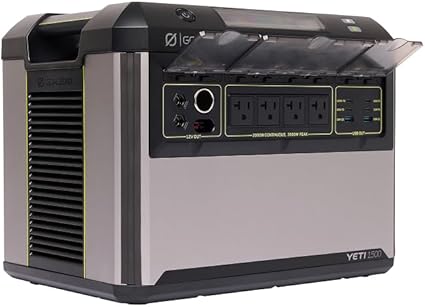
Goal Zero built its reputation on units that still work 10 years after you bought them. The Yeti 3000X is expensive for the capacity, but the build, ecosystem, and warranty support are why fire departments, first responders, and remote medical clinics still buy them. Integrates with the Home Integration Kit for whole-home transfer switching. If "it needs to work when I need it" is your top priority regardless of cost, this is the buy.
 Check Price on Amazon →
Planning Home Backup Power
Step 1: Identify Your Critical Loads
During an outage, what actually has to run? For most homes: refrigerator (150W avg), freezer (100W), modem/router (30W), a few LED lights (20W total), phone charging (5-10W), and maybe a medical device like a CPAP (40W). That's about 350W continuous, or 8.4kWh per 24 hours. A 2,000Wh unit covers 5-6 hours of essential loads before needing solar or recharge.
Step 2: Account for Startup Surges
Fridges and well pumps draw 3-6x their running wattage for 1-3 seconds at startup. A 150W fridge might surge to 800W. Your power station must handle the surge, not just the running load. Look for units with at least 2x surge capacity compared to your worst starting load.
Step 3: Factor in Outage Duration
How long do outages last in your area? Check your utility's outage records. For most US locations, the answer is "a few hours" — well within any 1,000Wh+ station's capability. For areas prone to multi-day outages (Puerto Rico, Texas during winter storms, California during wildfire season), you need 3,000Wh+ and solar to be realistic.
Step 4: Decide on Solar
Without solar, your power station is only useful for the duration of its stored capacity. A 2,000Wh unit with no solar gives you about 24-36 hours of essential loads and then stops working. Add 400W of solar panels and you extend that to indefinite — as long as the sun comes out. Solar costs about $400-800 for a panel array that meaningfully extends backup capability.
Step 5: Consider a Transfer Switch
For the highest tier of home backup, a transfer switch lets your power station feed a subpanel in your home — so when the grid fails, outlets, lights, and appliances on that subpanel automatically switch to battery. EcoFlow, Anker, and Goal Zero all make compatible transfer switches. Installation requires a licensed electrician, expect $500-1,500 all in.
Real-World Backup Scenarios
Winter Storm Outage (2-8 hours)
A 1,000Wh unit handles this easily. Fridge, lights, phones, modem. You might skip the dryer and toaster for a few hours. Any of the five units on our main list work.
Hurricane or Tornado (1-5 days)
You want 3,000Wh+ and solar. A Bluetti AC200P with a 400W solar kit will keep a fridge, lights, and devices running indefinitely through sunny post-storm weather. Plan for 60% solar efficiency due to debris on panels and partial overcast.
Wildfire PSPS Shutoff (2-7 days)
California Public Safety Power Shutoffs are now common during fire season. You want expandable capacity. The EcoFlow Delta Pro platform or Anker 767 with expansion battery is the play.
Medical Dependency (always)
If someone in your home relies on a CPAP, nebulizer, oxygen concentrator, or dialysis machine, redundancy matters. Get a 3,000Wh+ unit plus a smaller 1,000Wh backup. CPAP alone needs about 300Wh per night.
Shop Home Backup Power Stations
See our top picks on Amazon and get ready for the next outage.
Shop on Amazon →Frequently Asked Questions
What size power station do I need for home backup?
For essential loads like a fridge, lights, and Wi-Fi, plan on 2,000Wh minimum. For medical equipment plus essentials, 3,000Wh is safer. For whole-home backup with AC or heat, you need 5,000Wh+ or an expandable system like the Anker SOLIX F3800 or EcoFlow Delta Pro.
Can a portable power station replace a generator?
For outages under 48 hours, yes. Portable power stations are quieter, cleaner, and require zero maintenance. For outages over 48 hours you need solar recharging or a hybrid setup. Gas generators still win for multi-day outages with no sun, but they're loud and require fuel storage.
How long will a power station run my fridge?
A modern Energy Star fridge uses about 50-100kWh per month, or roughly 1.5-3kWh per day. A 2,000Wh power station will run most fridges for 12-36 hours depending on ambient temperature and how often the door is opened. Limit openings during outages to extend runtime.
Do I need a transfer switch?
For simple use cases (plug a fridge and a few lights into the unit directly), no. For whole-home integration where your panel switches to battery power automatically, yes — you need a manual or automatic transfer switch installed by an electrician. Some high-end units like the EcoFlow Delta Pro have integrated smart panels.
Will solar keep my power station charged during an outage?
It depends on load and panel size. A 400W solar array will generate about 2,000Wh on a clear day, enough to recharge a mid-size unit. Cloudy weather cuts output 50-80%. For reliable multi-day backup, size your solar for at least 150% of your daily load.
