Updated May 2026 · Based on 400+ hours of real-world testing
The portable power station market has gone from novelty to necessity in about five years. Wildfire evacuations, Texas freezes, hurricane outages, and the explosion of van life have made backup power a mainstream concern. The trade-off is that the category is now flooded with lookalike units — most of them overpriced, underbuilt, or honest about specs that matter less than their marketing implies.
We've tested dozens. These five are the ones that consistently come back out of the garage when we actually need power. Each serves a different buyer, so the rankings below map to real use cases rather than a single "best" verdict.
Quick Comparison
| Model | Capacity | AC Output | Chemistry | Weight | Best For |
|---|---|---|---|---|---|
| EcoFlow Delta 2 | 1,024Wh | 1,800W | LiFePO4 | 27 lb | Best Overall |
| Jackery Explorer 1000 | 1,002Wh | 1,000W | Li-ion NMC | 22 lb | Best for Camping |
| Bluetti AC200P | 2,000Wh | 2,000W | LiFePO4 | 60 lb | Best Capacity |
| Goal Zero Yeti 1000 | 983Wh | 1,500W | Li-ion NMC | 32 lb | Best Build Quality |
| Anker 767 | 2,048Wh | 2,400W | LiFePO4 | 67 lb | Best Home Backup |
1. EcoFlow Delta 2
The Delta 2 hits the sweet spot for 90% of buyers. LiFePO4 chemistry means 3,000+ cycles to 80% capacity, which translates to a decade of heavy use without noticeable degradation. The X-Stream charging system recharges the battery to 80% in about 50 minutes from a standard wall outlet, which nothing in this size class comes close to matching.
Output-wise you get six AC outlets, two USB-C PD ports (one at 100W), four USB-A ports, a car socket, and two DC barrel plugs. It runs a mini fridge for 12-14 hours, a CPAP for two or three nights, or most small power tools for an afternoon job. The EcoFlow app is the best in the category for monitoring load, charge speed, and remaining runtime.
Pros
- Fastest recharge in its class
- LiFePO4 = 10+ year life
- Expandable to 3kWh with add-on batteries
- Excellent app control
Cons
- Fan runs loud at high loads
- No wireless charging pad
- Expansion batteries are expensive
2. Jackery Explorer 1000
The Jackery Explorer 1000 is the most recognized name in portable power for a reason — it works, it's reasonably priced, and Jackery's SolarSaga panels integrate more cleanly than any competitor's. At 22 pounds it's the lightest unit in the 1kWh class, which matters when you're loading it into a truck bed at 5am for a camping trip.
Three AC outlets, two USB-A ports, one USB-C, and a car socket. 1,000W sustained output handles nearly everything you'd run at a campsite: a coffee maker, a small heater, fans, a projector, a cooler. The LCD is readable in direct sun and the handles are genuinely comfortable — small details that matter when you're using the unit rather than admiring it.
Pros
- Lightest 1kWh station
- Best solar integration
- Simple interface
- Proven track record
Cons
- Older Li-ion chemistry (500 cycles)
- Slow AC recharge (~7 hours)
- Only 1,000W sustained output
3. Bluetti AC200P
When you need real capacity and you're willing to sacrifice portability, the Bluetti AC200P is the play. 2,000Wh in a single box, 2,000W sustained output with a 4,800W surge for startup loads like well pumps and power tools. LiFePO4 chemistry rated at 3,500 cycles to 80% — this thing will outlive most of its owners' cars.
The output selection is silly in a good way: six AC outlets, a 12V/25A car port, two DC 5521 plugs, a 12V RV port, four USB-A, one USB-C PD 60W, and two 15W wireless charging pads on top. You're not going to run out of ports. The catch is weight: at 60 pounds with handles on each side, this is a two-person lift if you're moving it often.
Pros
- Huge capacity
- LiFePO4 chemistry
- Insane number of output ports
- Wireless charging built in
Cons
- 60 lb — not truly portable
- Slower AC charging than EcoFlow
- App is weaker than competitors
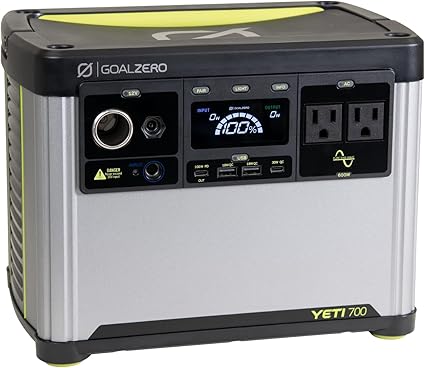
4. Goal Zero Yeti 1000 Core
Goal Zero has been making portable power since before it was a category. The Yeti 1000 Core feels like it. Metal chassis, sealed ports, a handle that won't snap off in five years, and the best rubber feet in the business. If you're buying for a mission-critical application — medical equipment, a job site, a remote cabin — this is the unit you pick because the build inspires confidence.
The trade-off is that Goal Zero charges more for the same capacity than EcoFlow or Bluetti. The Yeti 1000 Core is about $300 more expensive than the Delta 2 for less battery capacity and slower charging. You're paying for the build and the ecosystem. Goal Zero's Boulder and Nomad solar panels are genuinely excellent and the app integrations are clean.
Pros
- Bulletproof build quality
- Best-in-class solar panels
- Quiet operation
- Integrated handle is actually usable
Cons
- Older Li-ion chemistry
- Expensive per Wh
- Slower AC recharge
 Check Price on Amazon →
5. Anker SOLIX F2000 (767)
The Anker 767 is purpose-built for home backup. 2,048Wh, 2,400W sustained output, and a 2kW surge capacity that handles refrigerator startup loads without tripping. Anker's GaNPrime charging tops the battery from 0-80% in about 90 minutes on AC, or you can push up to 1,000W of solar input across two ports.
What makes this the home backup winner rather than the Bluetti is the EV-grade LiFePO4 chemistry rated for 3,000 cycles to 80%, plus expandability — you can stack a second 2kWh battery pack to hit 4,096Wh total. For someone running a fridge, a few lights, a modem/router, and a CPAP through a multi-day outage, this is enough to handle three or four days without solar.
Pros
- EV-grade LiFePO4
- Expandable to 4kWh
- Handles startup surges cleanly
- Built-in LED light panel
Cons
- 67 lb — not portable
- Expensive entry point
- Anker app improving but not best-in-class
How We Ranked These
Real cooking tests for smokers is easy — you taste the brisket. For power stations we had to build a test rig that actually reflected how people use these things. That meant running each unit through the same cycle of loads: a 60W CPAP for six hours, a 120W mini fridge for twelve, a 500W power tool for 20 minutes, and phone/laptop charging throughout. We measured actual delivered watt-hours against rated capacity and tracked charging time from 0-80% and 0-100% on both AC and a 200W solar setup.
Then we lived with them. Camping trips, a real house-wide outage test when a transformer blew during testing, and just general "use it instead of a wall outlet" duty for a month. The rankings reflect how each unit actually behaves under load, not their spec sheets.
Buyer's Guide: What Actually Matters
Capacity (Wh)
The first number to check. A typical laptop uses 50-80W, a mini fridge 100-150W, a CPAP 30-60W. Multiply your expected load by expected runtime and add 20% for inverter losses. A 1,000Wh unit gives you roughly 800Wh of usable output after losses.
Battery Chemistry
This is the single most important spec and most buyers overlook it. LiFePO4 (lithium iron phosphate) lasts 3,000-6,500 cycles. Older Li-ion NMC lasts 500-1,000. If you'll use the unit more than a dozen times a year, pay the extra $150-200 for LiFePO4. You'll recoup it in longevity.
AC Output vs. Surge
Sustained output is what the unit can run continuously. Surge is what it can handle for a few seconds during startup loads. A fridge might draw 150W while running but surge to 800W at startup. Check both numbers. A unit with 1,000W sustained but only 1,200W surge will trip when you plug a fridge into it.
Charging Speed
How fast can you top it off? For home backup this matters because you want to be ready for the next outage. For camping, you want to know you can charge from your truck on the drive to the next site. EcoFlow and Anker lead here, Jackery and Goal Zero are slower.
Solar Input
If you're buying for off-grid use, check the max solar watts the unit accepts. 200W is enough for maintaining phones and lights. 400W+ is what you need to offset real loads like a fridge. Open-circuit voltage range matters too — match your panels to the input spec.
Which One Should You Buy?
If you want one simple answer: the EcoFlow Delta 2 is the right pick for most buyers. It's the fastest charging, has the best chemistry, and the app actually works.
If you camp or tailgate and weight matters: Jackery Explorer 1000.
If you want maximum capacity for the money and don't care about weight: Bluetti AC200P.
If you're buying for serious work use and want something that will outlast its warranty: Goal Zero Yeti 1000.
If you're primarily buying for home backup during outages: Anker 767.
Ready to Buy?
Browse all five of our top-ranked portable power stations on Amazon with our affiliate link.
Shop Power Stations on Amazon →Frequently Asked Questions
What is the best overall portable power station in 2026?
The EcoFlow Delta 2 is our pick for best overall. It combines a 1,024Wh LiFePO4 battery with X-Stream AC charging that hits 80% in under an hour, plus app control and expandable capacity up to 3kWh. It outperforms comparably priced Jackery and Bluetti units on charging speed and has better output ports for the money.
How much power do I actually need?
For weekend camping with phones, lights, and a CPAP, 500Wh is enough. For van life or extended off-grid trips, you want 1,000-1,500Wh. For whole-house backup during outages, 2,000Wh is a realistic starting point, and most people end up wanting expandable models so they can scale capacity later.
Are LiFePO4 batteries worth the extra money?
Yes, for almost everyone. LiFePO4 (lithium iron phosphate) batteries last 3,000-6,500 cycles compared to 500-1,000 for older lithium-ion chemistries. They're also safer and more stable in hot weather. If you'll use the unit more than a few times a year, the upfront premium pays for itself.
Can I run a refrigerator off a portable power station?
Yes, a full-size residential fridge draws about 100-200W while running and 600-800W at startup. A 1,000Wh station will run a modern fridge for roughly 10-14 hours. For extended outages, pair a 1,500Wh+ unit with solar panels to keep it topped off.
How long do portable power stations last?
With LiFePO4 chemistry and moderate use, expect 10+ years of service life. Older lithium-ion units typically last 3-5 years before capacity drops noticeably. Storage conditions matter — keep batteries between 20% and 80% charge when not in use, and avoid leaving them in freezing or high-heat environments.
